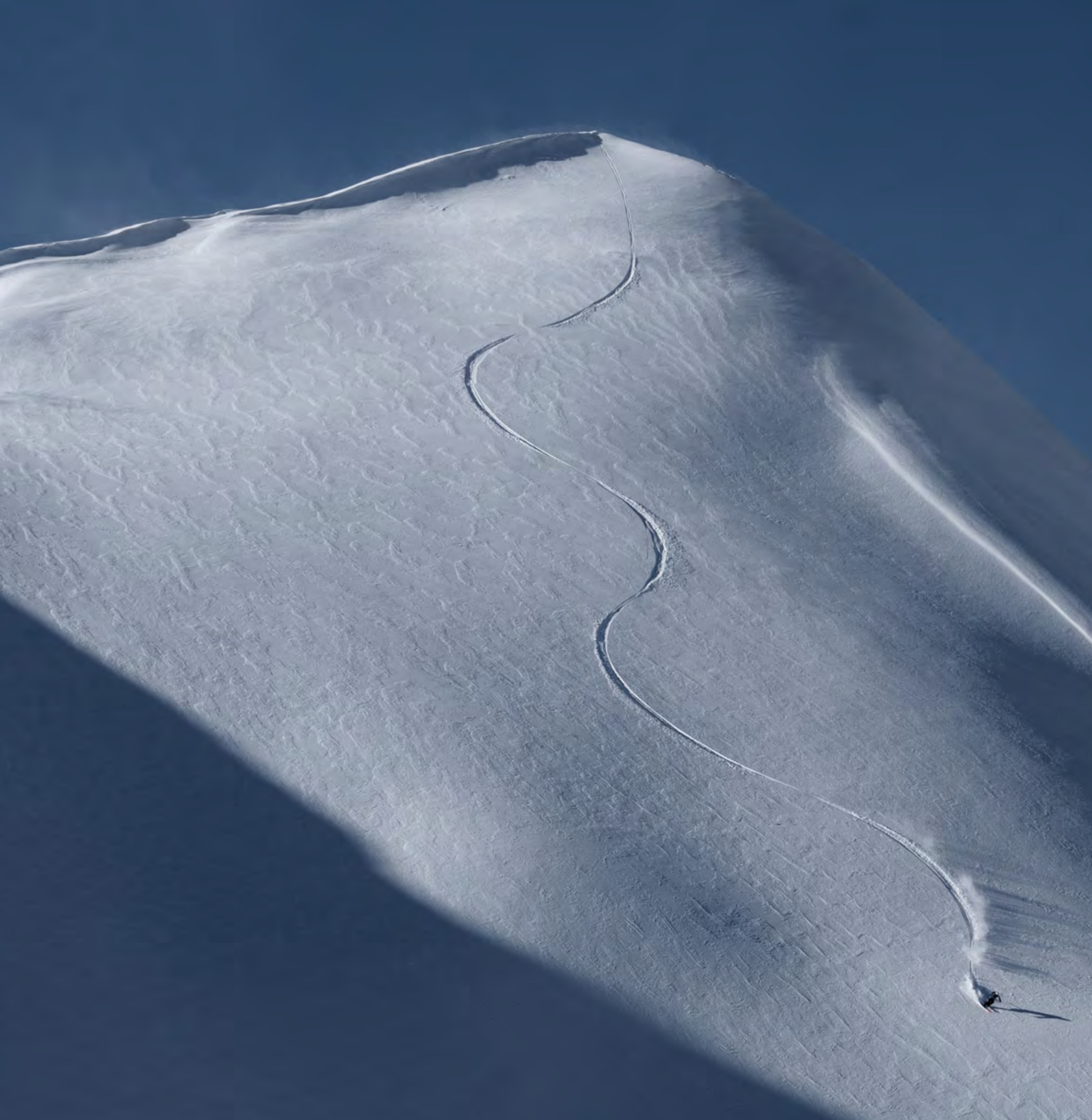
Italien · National Park Monti Sibillini (Apenninen)
Go Big, but Go Clean
Issue 2021 · Words: Alice Linari · Photos: Alice Linari · 5 min read
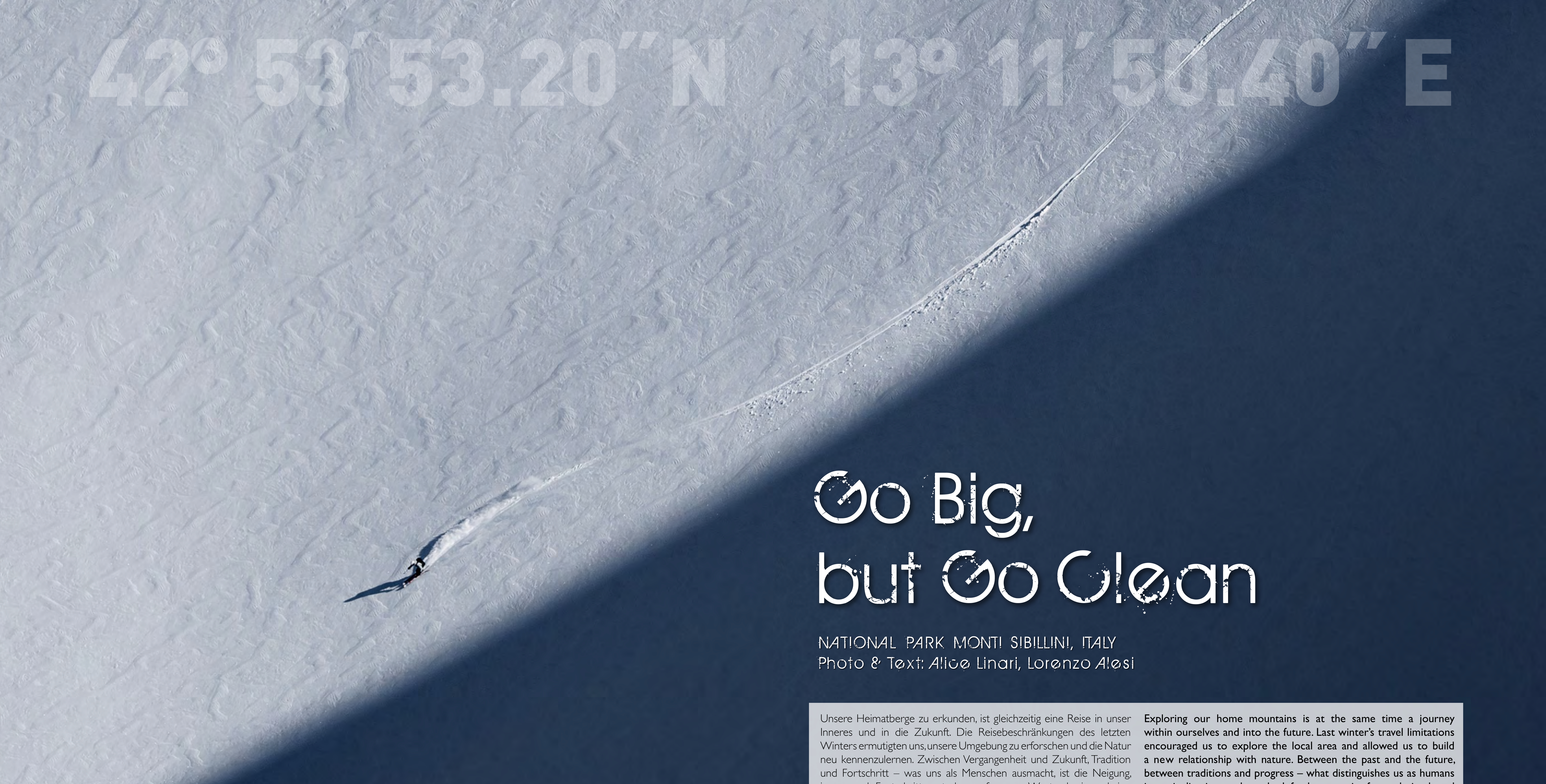
Exploring our home mountains is at the same time a journey within ourselves and into the future. Last winter's travel limitations encouraged us to explore the local area and allowed us to build a new …
Exploring our home mountains is at the same time a journey within ourselves and into the future. Last winter's travel limitations encouraged us to explore the local area and allowed us to build a new relationship with nature. Between the past and the future, between traditions and progress – what distinguishes us as humans is our inclination to always look further, to strive for evolution based on our values and our will to create a better future. We explore a vast and barely inhabited area in the Apennines, the Monti Sibillini National Park, from south to north. We cover longer distances on our electric motorcycles and then reach the peaks on our skis.
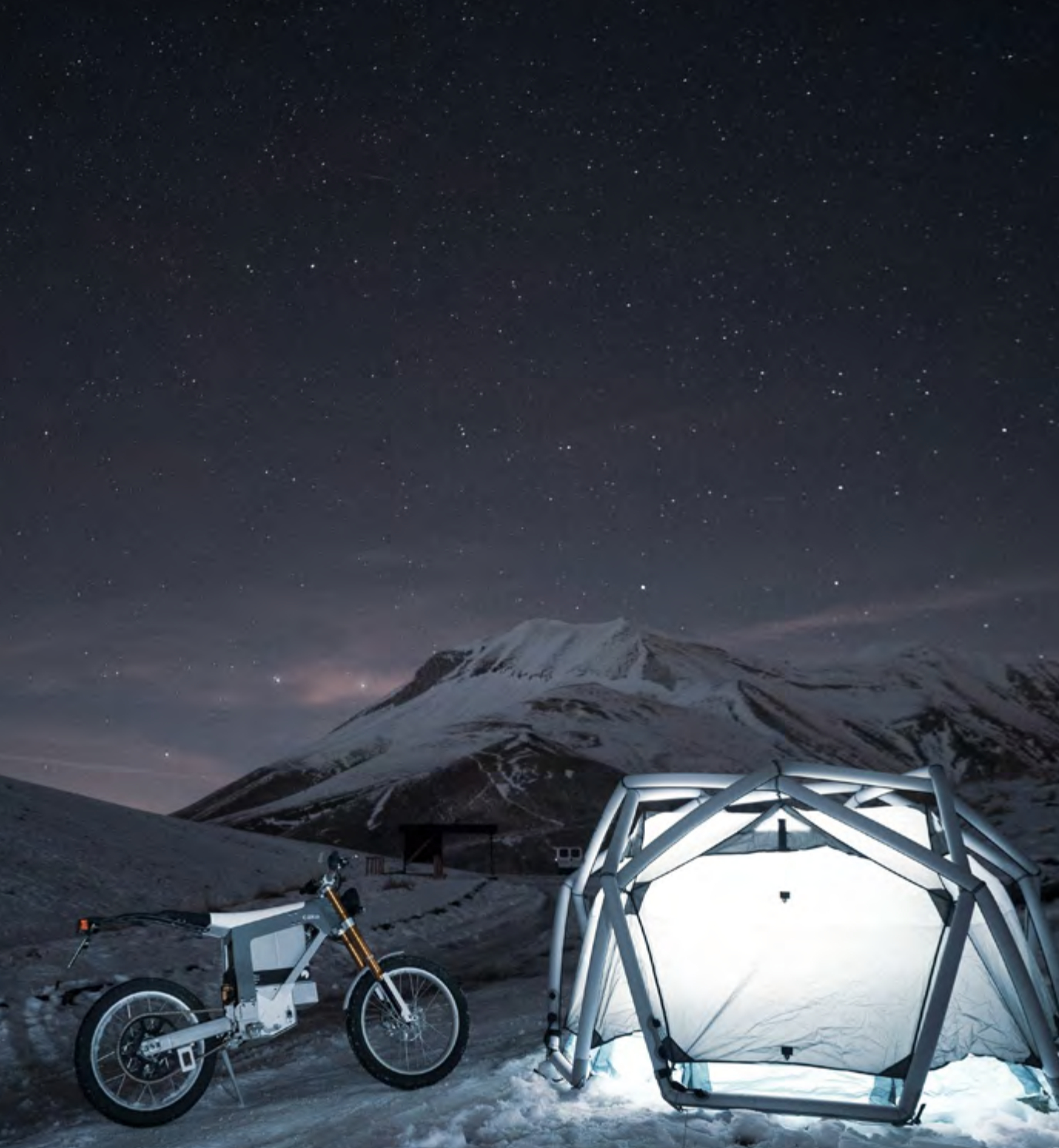
An experience of deep connection with nature that becomes even more intense when moving slowly with zero emissions. Our local exploration begins at Monte Vettore, the southernmost and with 2,746 meters also highest peak of the Sibillini range. The first night in our tent on the Forca di Presta is quite cold. Despite the latitude, the temperatures are low. Nevertheless, we enjoy a wonderful starry sky and a view of the Milky Way, which is easily visible here as light pollution is limited because only a handful of villages survived the 2016 earthquake. At sunrise, we begin our ascent to Rifugio Zilioli, the only bivouac above 2,000 meters in the area.
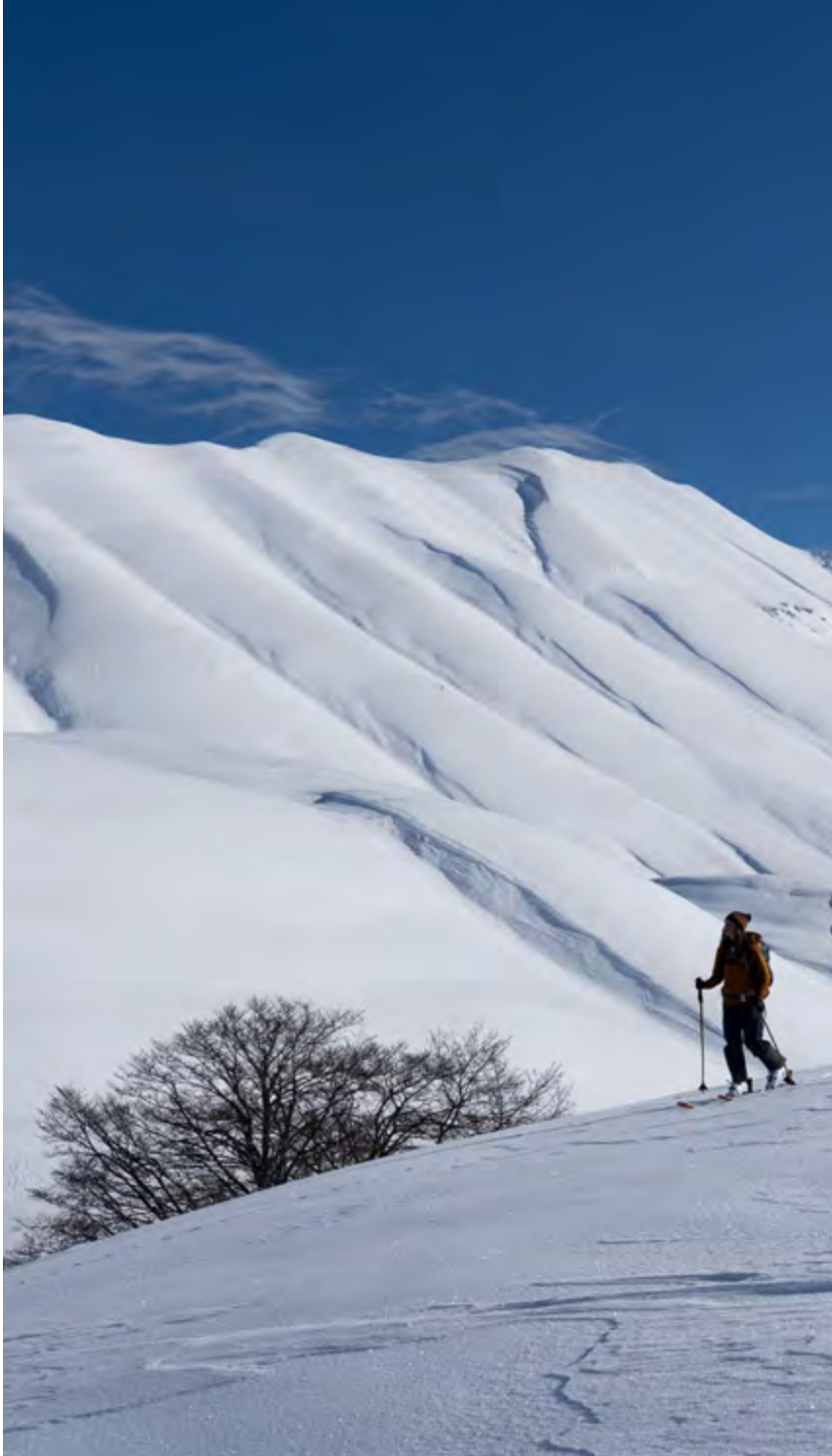
The abundant snowfalls of the past few days have made the area virtually inaccessible, so we have the mountains all to ourselves. The climb to the summit is steep but short: 700 meters of altitude in 1.5 hours to reach the Rifugio Zilioli, which looks beautiful covered with ice, like a sculpture. We climb from the west face towards Cima Redentore, looking for the best and safest face to ski down. With frequent avalanches, the valley of Lake Pilato is quite dangerous in winter. We reach the Cima di Prato Pulito, and from there the Cima Lago, walking on a steep ridge offering breathtaking views across the plain of Castelluccio, and on the south side over the Monti della Laga range and the Gran Sasso d'Italia, with 2,912 meters the highest summit in central Italy.
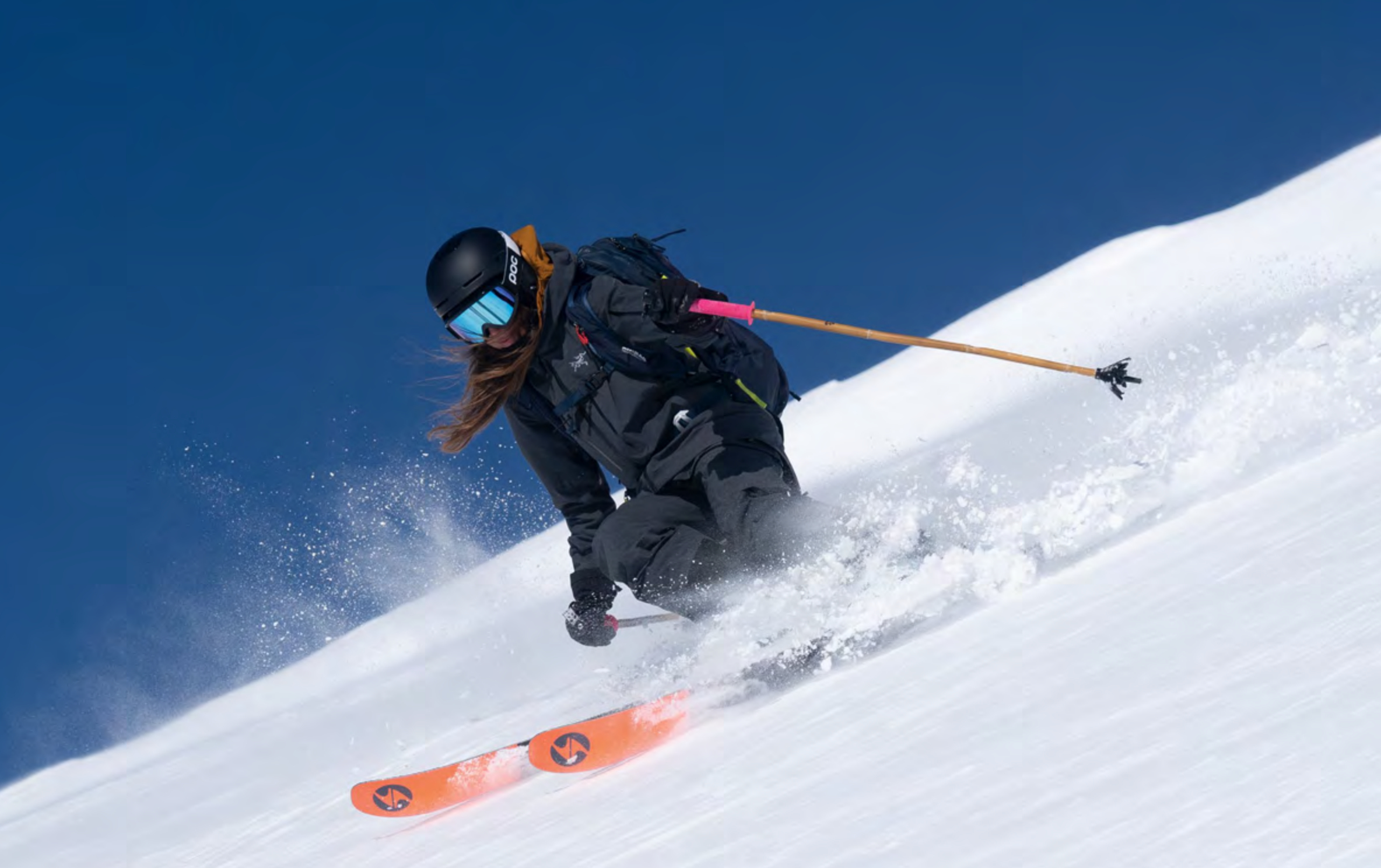
We love this vast area situated between two national parks – Monti della Laga and Sibillini and three regions of central Italy, the Marche, Abruzzo and Lazio. And then there it is, a wide untouched face, 500 meters of altitude with no tracks. The descent is fantastic. We ski amidst the lights and shadows created by the peaks of Cima di Prato Pulito and Redentore, drawing our lines gently caressing the snow, down to Valle Santa and the plain of Castelluccio. We don't often have such great snow conditions here, but this winter is magical here in the Sibillini. After two days, the local authorities reopen the road and we ride our e-motorcycles between unusually high snow walls to the north following the mountain range to climb Monte Argentella.
Riding the electric motorbikes to a trailhead and skinning up to the summit best embodies our concept of skiing by fair means. The ascent from Pian Perduto, just past the village of Castelluccio, is quite long: after a flat part crossing the plain, the trail climbs steeply. The view on the south side of Monte Vettore is beautiful: from this side, the summit looks like a big volcano. We see the village of Castelluccio, or what's left of it. It towers over the plain as if it were the sentinel of the area. We are now in the center of the mountain range; the summit of Monte Argentella looks like a balcony at 2,200 meters, from there we can admire the valley of Monte Vettore and Lake Pilato on the south side, the Adriatic Sea in the east, Palazzo Borghese, Monte Porche, Pizzo Berro, Monte Bove in the north and then Monte Sibilla, the peak eponymous of the entire mountain range.
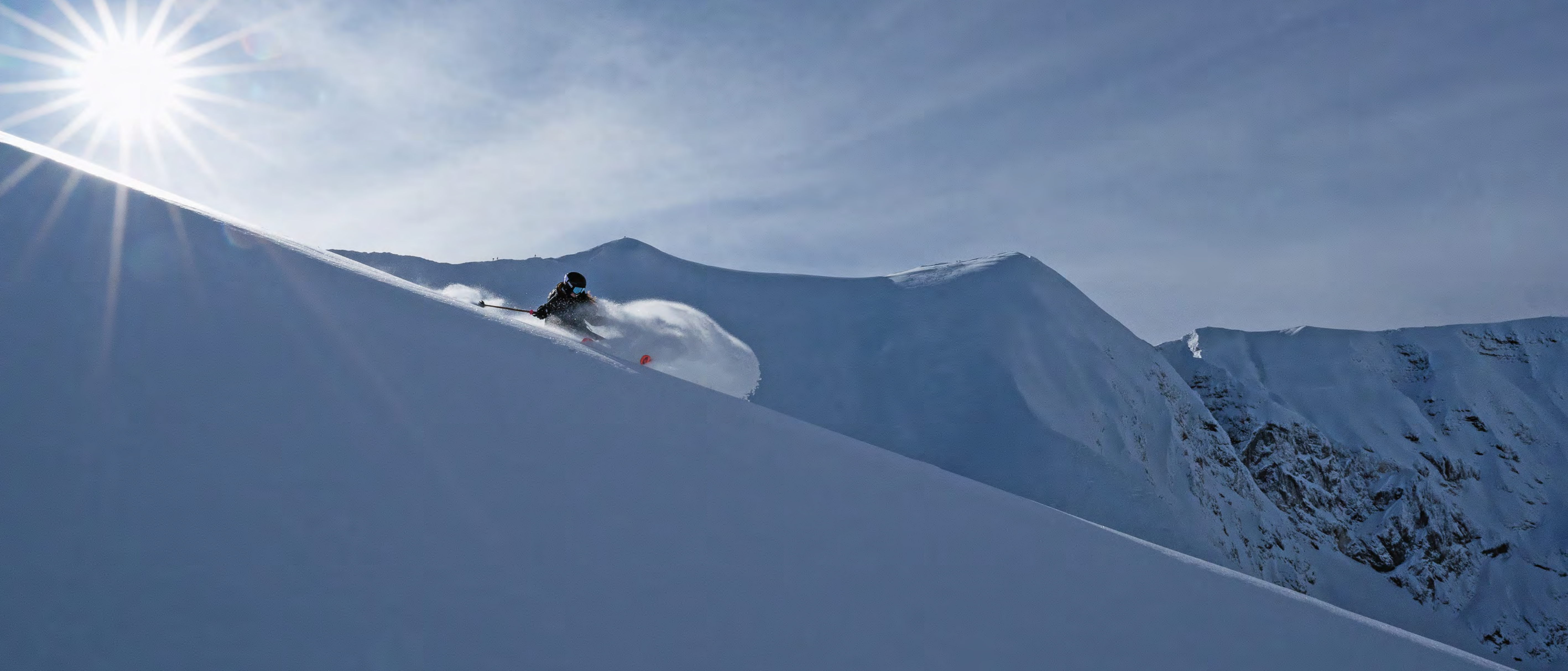
Legend has it that on the top of Mount Sibilla, there is the Fairy Cave. The sorceress Sibilla is surrounded by fairies who descend into the valley at night to meet the young shepherds. The legend says that once they meet the fairies, people become immortal and are forced to live in the enchanted cave, going out only at night. We ski down to the San Lorenzo couloir. The snow is fantastic and the landscape beautiful with numerous snowdrifts and the interplay of light and shadow on the west face of Monte Vettore. As we reach the Plain, we witness a fantastic sunset and admire the mountains turning pink. We hear no sounds, only that of the skis on the snow, and then that of the electric engines after we arrive back at our motorbikes.
A sustainable mobility is what we wish for to protect these beautiful places and our winters and give future generations the opportunity to explore the mountains and experience this same special connection with nature. We head north towards Forca di Gualdo, where we spend another beautiful night under the stars. The next day we go down to Castel S.Angelo sul Nera and then up towards Ussita, a beautiful medieval village badly damaged by the earthquake. Monte Bove, with the two summits south and north, is perhaps the most fascinating peak on the north side of the Sibillini range. The ascent is direct and the elevation not too high. Once we reach Monte Bicco, we walk along the south ridge until we reach Monte Bove South, at 2,169 meters.
From here, we admire the entire Sibillini range with all its peaks above 2,000 meters and glacial valleys: the beautiful amphitheater of the Pilato Lake valley, and Val di Bove and Val di Panico, where, because of the frequent spontaneous avalanches in winter, ski touring is mostly only possible in spring. Lenticular clouds like spaceships above the highest peaks make this scenery really special. We ski down on the west face, trying to stay away from the "camosciara", where the chamois live, the real inhabitants of this place. After a short ascent to Monte Bicco we return to Ussita, the final destination of our local journey, with the feeling of being fulfilled by the time spent in the mountains, connecting with nature while making an effort to do something for the environment.