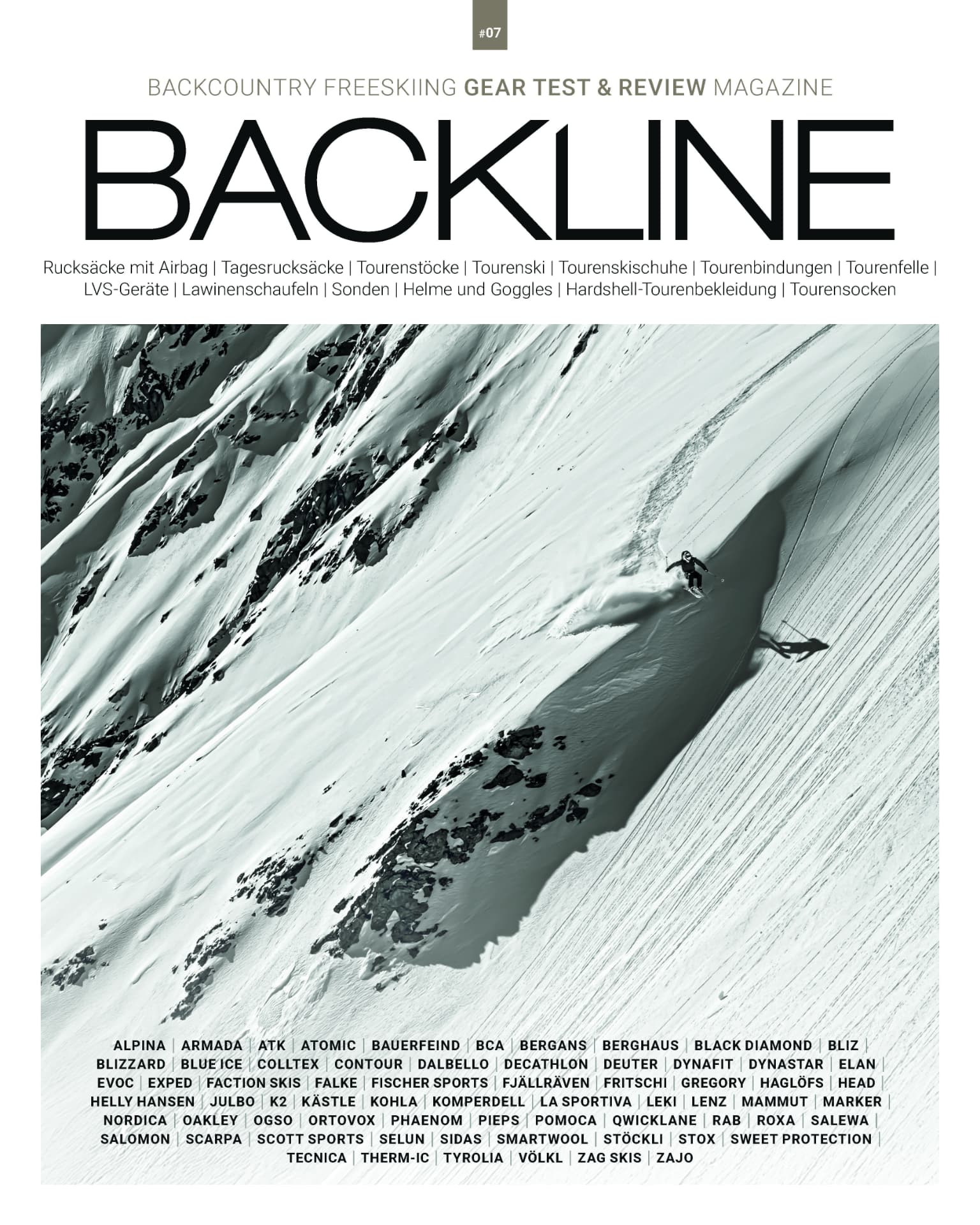
Ski touring helmets & goggles · Test magazine 2025
Tech talk with Nicolas Defude, JULBO
Product Manager · Print page 135
Who is Nicolas Defude? Helmet Product Manager at Julbo
Nicolas Defude is a product manager at Julbo, responsible for helmet development. He grew up in the Jura Mountains and has worked in the outdoor industry for more than 20 years. His mountain sports experience informs his work. In the BACKLINE 2025 test magazine, he explains the requirements ski touring helmets must meet during both ascents and descents.
His priorities are protection, low weight, ventilation and lasting comfort. Defude cites the HAILOT LT, which, according to the interview, meets the EN1077 and ASTM 2040 ski helmet standards as well as the EN12492 climbing helmet standard. Its features include MIPS and an integrated RECCO system. He explains that Julbo reduces weight through an optimised helmet shape, lightweight textile components, ventilation channels and simplified adjustment systems.
For sustainability, Defude emphasises durability and efficient material use. Recycled materials are being evaluated but are not yet ready for series production; packaging made from FSC-certified paper and cardboard is already in use. For future development, he highlights compatibility with headlamps, goggles and sunglasses, alongside backpack attachment options. In the longer term, he sees potential in lightweight, sustainable materials that withstand repeated impacts.
Julbo is primarily known for high-quality eyewear – what makes your ski touring helmets special, and what do you focus on in development specifically for touring use?
Julbo is based in the French Jura, just a stone's throw from alpine hotspots like Chamonix or Zermatt. In this environment, it's natural to be active outdoors year-round – hiking, trail running, freeriding, or ski touring. In addition to highly functional eyewear, we have therefore been developing helmets for about 20 years. Our focus on ski touring grew out of this tradition. With the new HAILOT, we are now presenting our third dual-certified helmet (Ski + Mountaineering). The name is symbolic of our philosophy: "How Awesome is Life On Top." Touring helmets must be more versatile than classic ski helmets, as they are also worn on ascents – often in couloirs with a risk of rockfall. The challenge lies in combining protection, low weight, breathability, and comfort over many hours.
What safety-relevant innovations have you integrated into your current ski touring helmets – and how do they differ from classic ski helmets?
The HAILOT LT meets European and US standards for ski helmets (EN1077, ASTM 2040) as well as the European standard for climbing helmets (EN12492). This means it protects against both falls and rockfall. Additionally, it uses MIPS technology, which reduces the risk of brain injuries from oblique impacts, and an integrated RECCO system, which facilitates localization for avalanche rescue services. This offers protection in all phases of a tour – and clearly distinguishes it from classic ski helmets, which are primarily designed for piste environments.
Especially in ski touring, every gram counts – how do you manage the balancing act between lightweight construction and maximum safety?
Safety is the top priority, yet we save weight through detailed work. An optimized, low-profile shape allows for material reduction while ensuring full head coverage. Lightweight textile components, a well-thought-out inner lining, and a size system reduced to the essentials also contribute. Ventilation channels ensure a pleasant climate and less weight, without compromising shock absorption. Even small details like a non-magnetic chin strap buckle or lightweight adjustment systems make a difference.
What role does sustainability play in the development of Julbo ski touring helmets?
Since ski touring is very material-intensive, we place particular emphasis on durability. Robust materials guarantee a long lifespan – provided no fall necessitates a replacement. Every component is designed for minimal material use, wherever possible with perforated structures for high stability with reduced resource consumption. The use of recycled materials is currently under review but not yet ready for series production. Sustainable packaging made from FSC-certified paper and cardboard is already implemented.
How does Julbo see the future of the ski touring helmet – what features will become more important?
Ski touring in its modern form is still a young segment – accordingly, the potential for practical innovations is great. The variety of conditions encountered – from day and night activities to changing weather conditions and the constant alternation between ascent and descent – requires helmets that interact optimally with the rest of the equipment. This includes mounting options for headlamps, seamless compatibility with ski and sunglasses, and solutions for easy attachment to a backpack. The development of lightweight, functional features to enhance comfort knows almost no bounds. One example is the HAILOT LT, which is optionally equipped with an ultralight trail cap: It protects against sun and snow during the ascent and can comfortably stay on the head even when handling climbing skins. In the long term, the focus is also on new material concepts: lightweight, sustainable, and at the same time resistant to repeated impacts – a crucial step to more closely link safety, comfort, and environmental awareness.