USA · Cascade Range
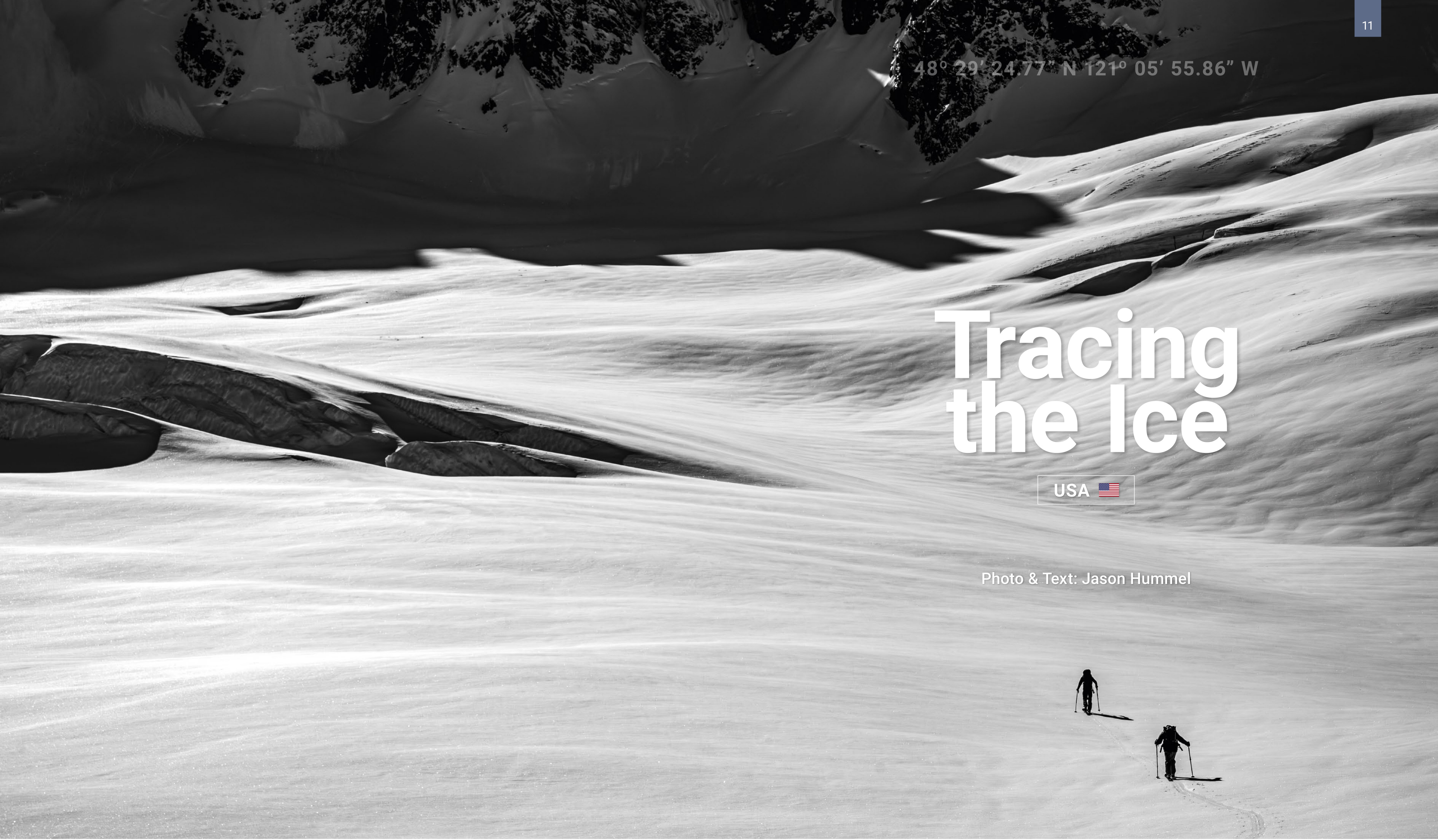
Tracing the Ice
Issue 2025 · Words: Jason Hummel · Photos: Jason Hummel · 3 min read
Ice is a book, a story of Earth’s past. Only near the very end of their eons-old story do you find lines written by humans. What are their stories? What brought them to those icy shores? Where have my own tracks intersected theirs – and how long will those faint lines endure before the next storm …
Ice is a book, a story of Earth’s past. Only near the very end of their eons-old story do you find lines written by humans. What are their stories? What brought them to those icy shores? Where have my own tracks intersected theirs – and how long will those faint lines endure before the next storm erases them again? More than two-thirds of all glaciers in the contiguous United States are located in the mountains of my home state of Washington. Only here does snow gather to such depths that even seasons can’t erase them. At times more than a thousand inches falls in a single winter – enough to humble every kind of snow slider before the Snow Gods who gift such bounty. Yet these glaciers are vanishing, growing more fallow each year.
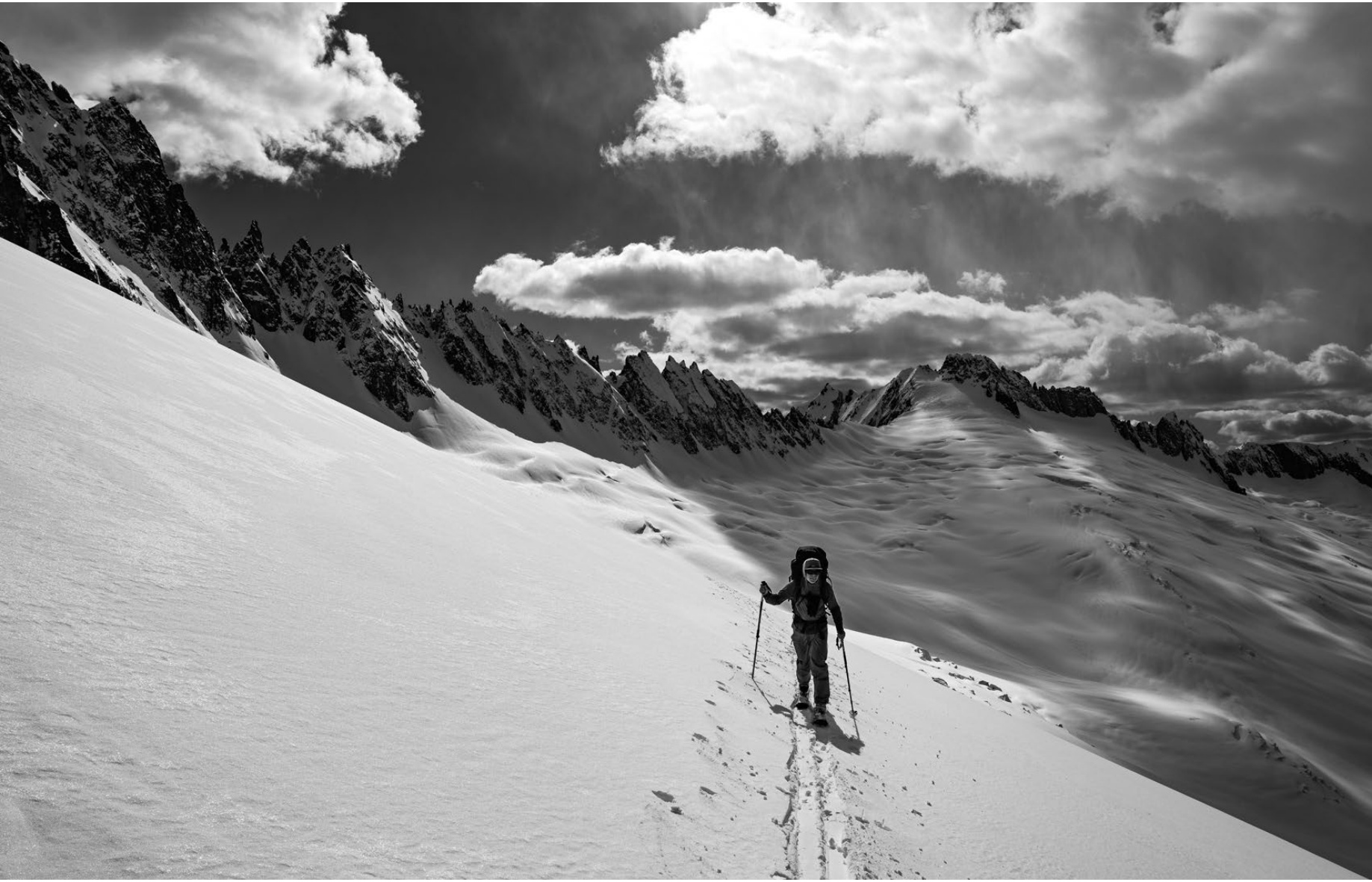
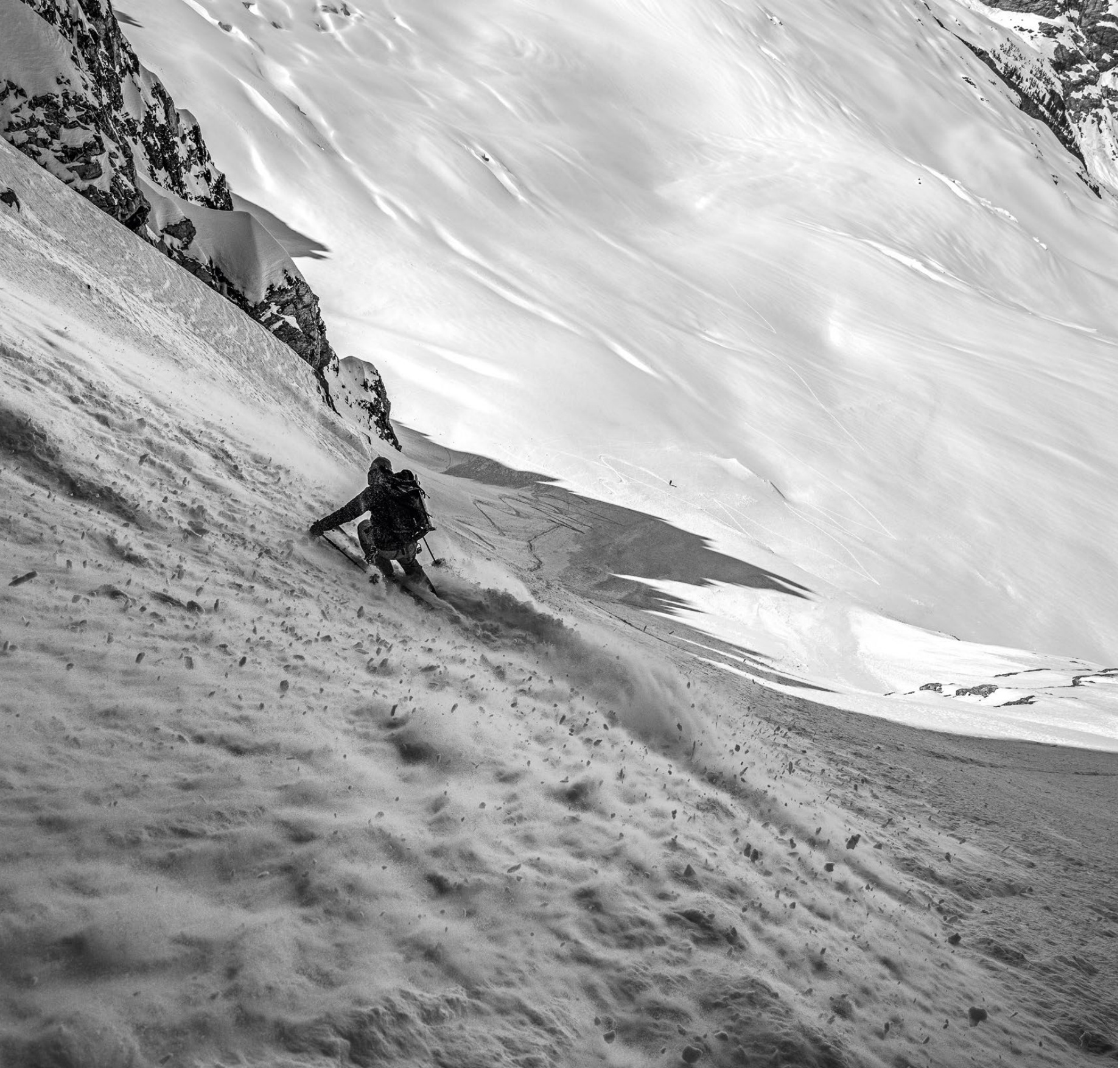
That reality confirms why it matters to capture their stories, to ask what these places mean to us – and to me. This is why I’ve endeavored to chronicle, ski and photograph all of Washington’s glaciers, with the North Cascades as the final frontier. Astride their peaks lie the last icefields I’ve yet to visit, scattered across ranges I’ve already traversed in countless ways. But there is always room for new lines in bootpacks, switchbacks and sweeping turns. Last year, I circumnavigated Mount Buckner (9,114 feet), one of the highest peaks in the range. Along the way, I not only tagged four glaciers I’d never visited, but I followed in the footsteps of Native Americans, prospectors, writers, travelers and fellow skiers.
Their awe reveals how impossibly wild, inspiring and, at times, frightening these places remain. So it was in approaching Mount Buckner and passing beneath Johannesburg Mountain (8,200 feet). In 1896, Lawrence Kaye Hodges reported on prospectors here and described the “roar and rattle [that] draws your attention to the mountain opposite, where every gulch between the unscalable sawteeth is filled with a narrow, tumbling stream of ice, broken into huge waves.” That roar is born high on the Johannesburg Glacier, once known to miners as “Shivering Glacier.” Circling Buckner with Carl Simpson and Ashton Richie, I climbed onto the Quien Sabe and Boston Glaciers, where we
tried the North Face of Buckner, first skied in 2002 by Fred Marmsater, Andrew McLean, Petra Pirc and Martin Volken. But sun had iced the summit pitch, forcing us to descend powder and chase it around to Thunder Creek Glacier, which no group has skied as far as I know, though Lowell Skoog led a ski party there in 1987. My next glacier was the Fremont, named for John Charles Frémont, a controversial army officer, scientist and politician of the mid-1800s. Forest supervisor Albert “Hal” Sylvester likely honored his scientific work, just as he named the Wyeth, Douglas, and Lewis Glaciers after other explorers of the American West. The final two glaciers in my circuit were Buckner and Davenport.
Mount Buckner itself is named for prospector Henry Freeland Buckner (1851–1910), who managed a mine in Horseshoe Basin. According to his nephew Harry, a crew of 30 men and one woman, Lydia George, spent the brutal winter of 1909–10 there. Avalanches buried their cabin completely, forcing them to tunnel through snow just to breathe. His men dug 500 feet into the mountain near the Davenport Glacier at eight inches per day. I tried to locate remnants of the Davenport mine, but failed. It’s striking to imagine the efforts of Morrison M. Kingman (1859– 1938) and Joseph L. Pearsall, who first located it in 1890.
Pearsall was famed for discovering the Monte Cristo mines, but it was Kingman – who had lived in Davenport, Washington, and was a friend of John C. Davenport – who gave the mine and glacier their names. Before descending, I stood alone in the spine of Horseshoe Basin, its cliffs stretched like an open book. Pages of peaks lay fanned out before me, composing the North Cascades. Yet it’s what lies hidden in the folds of terrain that matters most: the footprints and stories still locked in the ice, waiting to be revealed.